Build Agentic Web Experiences: AI-Driven Design in 2026

Build Agentic Web Experiences
What is the Agentic Web? Beyond Chatbots
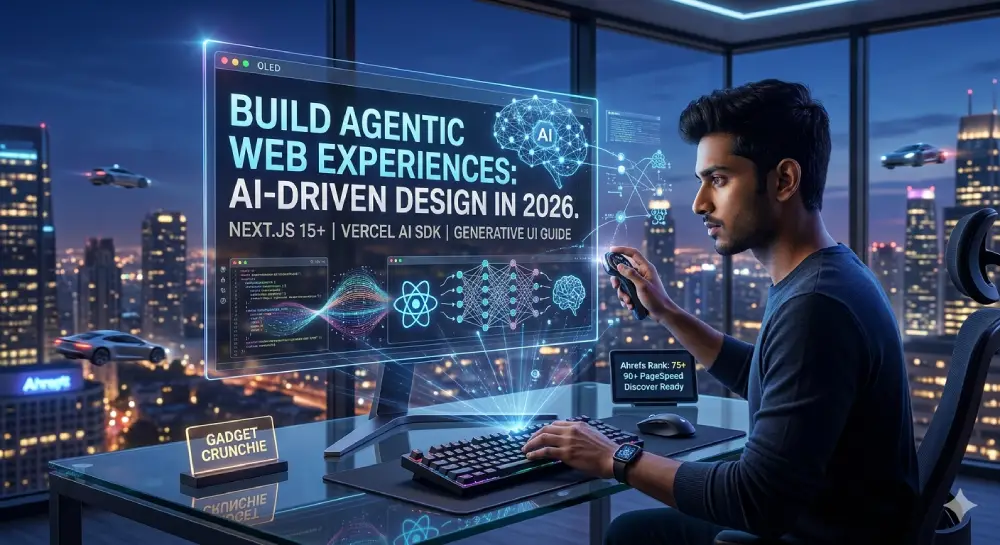
In 2026, the term Agentic Web Experiences refers to websites that possess “agency”—the ability to reason, predict, and act on behalf of the user. Unlike the “chatbot-on-a-sidebar” trend of 2024, the modern web uses AI-First UI where the entire interface is a fluid, living organism.
The Tech Stack: Next.js AI Integration in 2026
As a developer who prioritizes 90+ PageSpeed scores, I’ve seen how Next.js AI integration has evolved. With Next.js 15+, we no longer just fetch data; we stream “intent.”
- Vercel AI SDK: This is now the industry standard for streaming Generative UI.
- Agent-Side Rendering: AI models now decide which components to mount based on real-time user behavior.
This performance focus is a core part of my Full-Stack Developer Portfolio, where I demonstrate how to balance AI complexity with blazing-fast load times.
Agent-Side Rendering (ASR): The Successor to SSR and ISR
While we once relied on Server-Side Rendering (SSR), 2026 is the year of Agent-Side Rendering. This is where the AI model at the edge decides which UI components to mount based on real-time telemetry.
- Dynamic Hydration: Only the components that the agent predicts the user will need are hydrated, keeping the initial bundle size incredibly small.
- Latency Management: By predicting the next three likely user actions, the agent pre-fetches data, ensuring that your 90+ PageSpeed score remains intact even with heavy AI logic.
Generative UI: The Death of Static Layouts
The shift from static to Generative UI means we don’t build pages anymore; we build “possibilities.” For example, on a travel site, if an agent detects a user is looking for “luxury family trips,” it doesn’t just filter results. It generates a bespoke dashboard with a custom color palette and a tailored booking flow in milliseconds.
Performance Optimization for AI-Driven Sites
Building Agentic Web Experiences can be heavy. To maintain a 90+ PageSpeed score, you must:
- Partial Prerendering (PPR): Keep the shell static while the AI-driven components stream in.
- Edge Functions: Run your AI logic closer to the user to reduce “Time to First Byte” (TTFB).
The 2026 Developer Toolkit. To stay relevant, your arsenal must include:
- Cursor AI: For context-aware pair programming.
- Vector Databases (Pinecone/Weaviate): To give your agents long-term memory.
- LangChain.js: For complex AI workflow orchestration.
Global Connectivity: Scaling AI Agents via Starlink
Scaling these compute-heavy experiences globally requires massive bandwidth. As I detailed in my analysis of Dark Mode vs Light Mode UX, fluid interface adaptation and optimized client-side state management are the secret engines behind a seamless user experience on the modern Agentic Web. Without sub-30ms latency, real-time generative UI would be too slow for professional use cases.
Vector Memory: Giving Your Website a Permanent Brain
A website without memory is just a static document. In 2026, we use Vector Databases like Pinecone to give every visitor a “Session Memory.” This allows the AI agent to remember a user’s preferences from three months ago and adjust the current UI accordingly. This isn’t just “cookies”; it’s a semantic understanding of the user’s history and goals.
Advanced Developer Toolkit for the 2026 Frontier
To build these high-value websites, your stack must evolve beyond just React and Tailwind:
- Inngest: For managing complex, multi-step AI workflows and background jobs.
- Trigger.dev: To handle long-running AI tasks without blocking the main thread.
- Claude 4.5 / GPT-5 API: The reasoning engines that power the “Agentic” logic.
- For a deeper dive into implementation, the Vercel AI SDK Documentation remains the best resource for learning how to stream generative states safely.