On-Page SEO Checklist 2026: The Ultimate Guide for Developers

On-Page SEO Checklist 2026
In 2026, the SEO landscape has shifted from “matching keywords” to “solving problems.” With Google’s AI Overviews (formerly SGE) and AI-driven search intent dominating the SERPs, your website needs more than just meta tags to rank. It needs a soul.+1
As a solo web developer, I’ve seen how traditional SEO “hacks” have faded. Today, Google prioritizes pages that demonstrate real-world experience. This guide isn’t just a list of rules; it’s a strategic framework to ensure your site is both human-centric and search-engine-ready.
1. Search Intent & Semantic Content Strategy
In 2026, Google’s NLP (Natural Language Processing) is incredibly sophisticated. It no longer looks for the exact string “On-Page SEO Checklist” repeatedly; it looks for the entities and solutions associated with it.
The “Answer-First” Framework
Google’s AI models prefer content that is “extractable.” To rank in AI Overviews, use the Inverted Pyramid style:
- Direct Answer: Provide a 40–60-word summary at the very beginning of your section.
- Supporting Data: Back it up with stats or a quick code snippet.
- Deep Dive: Explain the “how” and “why” for the human reader.
Solo Dev Pro-Tip:
Don’t just target high-volume keywords. Use tools like Google Trends or Rank Math’s Keyword Research to find “Zero-Volume” keywords—specific questions real users ask in forums that tools haven’t caught yet.
2. Technical Precision: Beyond Basic Tags
While Rank Math helps you nail the basics, 2026 demands a deeper technical integration. Your code structure is now a direct ranking signal.
Exact Match Optimization
For Rank Math to give you that 100/100 score, ensure your Focus Keyword is an exact match in the following:
- Permalink:
yourdomain.com/on-page-seo-checklist/ - SEO Title: Must start with the keyword.
- H1 Tag: Should mirror the SEO title almost exactly.
- First Paragraph: Include the exact phrase within the first 50 words.
Structured Data (Schema.org)
Schema is the language you use to talk to AI. Don’t just use “Article” schema. For a checklist, implement FAQ Schema and How-To Schema. This increases your chances of winning “Rich Snippets,” which have a significantly higher Click-Through Rate (CTR).
3. Performance & The “Experience” Signal
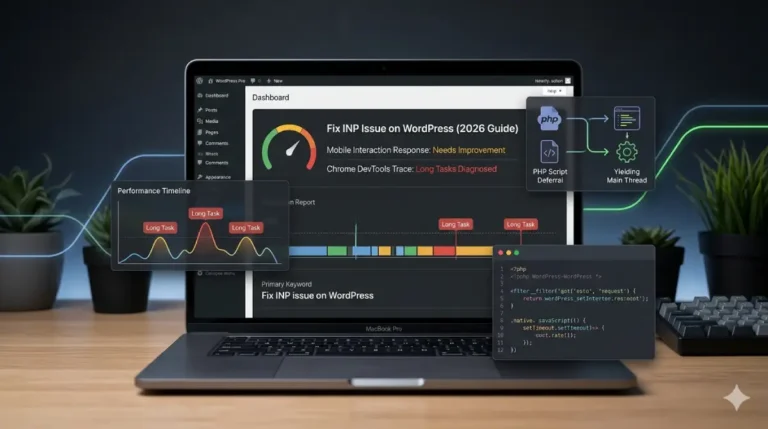
Google’s Core Web Vitals have evolved. In 2026, the most critical metric is INP (Interaction to Next Paint). It measures how fast your site reacts when a user clicks a button or menu.
Speed Optimization for 2026:
- LCP (Largest Contentful Paint): Aim for under 1.2s.
- INP (Interaction to Next Paint): Keep it under 200ms. If you’re a dev, minimize heavy JavaScript execution on the main thread.
- Image Compression: Use WebP or AVIF formats. An image over 100KB is a penalty in waiting.
If your site speed is struggling, check out my detailed guide: Custom Web Development for Small Businesses: 2026 Guide. I explain why hand-coded sites consistently outperform heavy templates.
4. E-E-A-T: Proving You Are a Human
With the web flooded by AI content, Google is desperate for Experience. This is your biggest advantage as a solo developer.
- Author Bylines: Don’t just list “Admin.” Use your full name and link to a detailed “About” page that shows your degree and projects.
- Case Studies: Instead of saying “SEO is important,” say “In my 2025 Dubai project, I improved organic traffic by 40% using these steps.”
- External Linking: Link to high-authority sources like Google’s Official Search Quality Guidelines to show you’ve done your homework.
- Verified Work: Don’t just take my word for it—take a look at my Developer Portfolio to see how I’ve implemented these SEO strategies for clients in the US, Germany, and others
5. Image & Multimedia SEO
Images are no longer just “visual aids.” With Google Lens and visual search, they are traffic drivers.
- Alt Text: Don’t just keyword stuff. Describe the image for a blind user while naturally including your keyword.
- Captions: Google now uses text near the image to understand its context.
- Video Integration: Host a short 60-second summary on YouTube and embed it. This increases “Dwell Time,” a massive signal for quality.
6. Advanced Internal Linking Architecture
Stop linking randomly. Use a Silo Structure.
- The Pillar Page: This post is your “Pillar.”
- The Clusters: Link out to specific sub-topics like “Mobile UX Optimization” or “Schema Markup Guide.”
- The Hook: Use descriptive anchor text. Instead of “Click here,” use “See our full Technical SEO Audit services.”
7. Mobile-Only Indexing & UX
Google has officially moved to Mobile-Only Indexing. If your site doesn’t work on a $200 Android phone, you won’t rank on a $2000 MacBook.
- Touch Targets: Ensure buttons are at least 48x48px.
- Font Size: Never go below 16px for body text.
- No Interstitials: Avoid annoying pop-ups that cover content on mobile.
2026 On-Page SEO Checklist (Summary Table)
| Element | Requirement | Why it Matters |
|---|---|---|
| Title Tag | Under 60 chars; Keyword at start | Human CTR + Rank Math Score |
| Meta Description | 140-155 chars; Include CTA | Improves Click-Through Rate |
| Header Tags | H1 (Primary), H2-H3 (Sub-topics) | Readability & Semantic Flow |
| Content Length | 1000+ words (Depth > Length) | Establishes Topical Authority |
| LCP Speed | < 1.2 Seconds | User Retention & Core Web Vitals |
| Internal Links | 3-5 Relevant Internal Links | Distributes Link Equity |
| External Links | 2-3 Authority Citations | Build Trust with Google |
Conclusion: The Solo Developer Advantage
SEO in 2026 isn’t about outsmarting the algorithm; it’s about out-serving the user. By combining your technical skills (clean code, fast loading) with authentic, human-written content, you can outrank big agencies that rely on generic AI outputs.
Stay consistent, monitor your Google Search Console weekly, and always prioritize the person reading your screen over the bot crawling your code.
Ready to Rank? If you need a custom SEO strategy or a high-performance website built from scratch, feel free to Contact Me. I’ll personally review your site’s technical health and help you scale.